There are many reasons why we need to transform school lunches. As discussed in this blog childhood obesity is increasing at an alarming rate and has more than tripled in the past 30 years. This crisis has prompted parents, teachers, and leaders to provide healthier food options as well as review the nutritional standards, which have not been updated in over 15 years (Parsons, 2001, p. 1). Even though it's very clear that school lunches need a makeover, it is a surprisingly complex and controversial topic. "It is an issue of money, history, policy, and children's dietary choices"(Aiken, 2010, p. 1). Government policies make it difficult to change school lunches because school lunch programs are federally funded by a complex web of manufacturers who spend millions of dollars on advertising. It is also difficult to change peoples’ attitudes and perceptions about food.
Current research shows that healthy lifestyle habits can decrease the rate of obesity. That is why it is so important to give children the building blocks for a healthier future. Every child deserves fresh and healthy food. We must end the highly processed food in schools and reconnect children to gardening, lunch prep, and cooking. This means learning how to cook, understanding where food comes from, and recognizing the power it can have on our health, happiness, and finances.
References:
Aikens, L. (2010, November 1). What Will it Take To Change School Lunch? | WakeMed Voices. WakeMed Voices. Retrieved June 6, 2011, from http://wakemedvoices.org/2010/11/what-will-it-take-to-change-school-lunch/
Owens, J. O. (n.d.). Sleep: The Missing Link in Preventing Childhood Obesity | Intent.com. Intent.com | Dream It, Share It, Achieve It. Retrieved June 6, 2011, from http://www.intent.com/nancyrothstein/blog/sleep-missing-link-preventing-childhood-obesity
Parsons, S. (2011, April 16). What's Going On with School Lunch Reform?. change.org. Retrieved June 3, 2011, from https://news.change.org/stories/whats-going-on-with-school-lunch-reform
Monday, June 6, 2011

Sunday, June 5, 2011
Get Involved
Take action with One Tray. www.onetray.org
Nourish the nation ONE TRAY at a time: Support Farm to School Programs and invest in child nutrition.
I love this organization and both of these videos because they are created with the help of students. These videos' are simple and to the point. The medical costs of obesity and diabetes is staggering. Healthy food does cost more money, however it's an investment in our future and it's all worth it!
Nourish the nation ONE TRAY at a time: Support Farm to School Programs and invest in child nutrition.
I love this organization and both of these videos because they are created with the help of students. These videos' are simple and to the point. The medical costs of obesity and diabetes is staggering. Healthy food does cost more money, however it's an investment in our future and it's all worth it!
Jamie Oliver's TED Speech
Jamie Oliver won the TED prize in 2010. This video is a little long, but worth watching as Jamie helps to educate every child about food, inspire families to cook and empower people everywhere to fight obesity.
History of School Lunch Programs
School lunch programs began in the 1930’s as a way to provide food for low-income families and to help dispose of surplus agriculture. “From the outset, they had two purposes: to help dispose of surplus agricultural commodities owned by the government as a result of price-support agreement with farmers , and to help prevent nutritional deficiencies among low-income schoolchildren” (anonymous, 2011). In the 1980's school populations were growing and schools were not able to keep up with school lunches. Schools turned to outside vendors to provide meals and additional income and pizza and soft drink companies led the way. “By the 1990's fizzy sugary drinks had replaced milk and pizza was the favorite meal” (anonymous, 2011).Over the last 10 years parents, educators, and doctors have become alarmed at the increasing rate of childhood, adolescent and adult obesity. These reformers called for an end to vending machines and fast food and have suggested ways to reconnect children to food by gardening, lunch prep, and cooking.
 from: http://www.drsoram.com/2010/06/solving-the-problem-of-childhood-obesity-within-a-generation/
 from: http://www.drsoram.com/2010/06/solving-the-problem-of-childhood-obesity-within-a-generation/
References:
School Lunch. (n.d.). The FOOD Museum : What's New. Retrieved June 6, 2011,
from http://www.foodmuseum.com/exhbitschoollunch.html
Wednesday, June 1, 2011
Visual Illustrations of Childhood and Adolecent Obesity
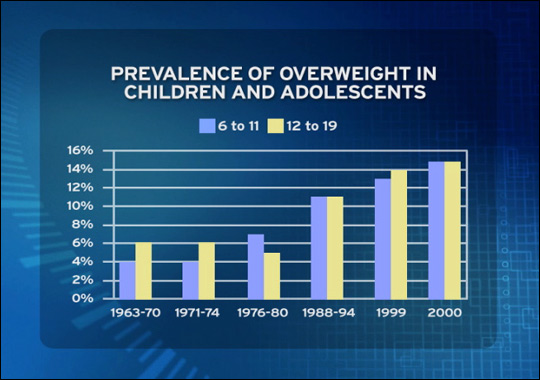
This chart from ("DiscoveryHealthCME :: Childhood Obesity :: Photos :: Charts." DiscoveryChannelCME :: Continuing Medical Education. N.p., n.d. Web. 1 June 2011.
| Years | Boys | Girls |
|---|---|---|
| 1966-1970 | 4.5 | 4.7 |
| 1971-1974 | 6.1 | 6.2 |
| 1976-1980 | 4.8 | 5.3 |
| 1988-1994 | 11.3 | 9.7 |
| 1999-2000 | 14 | 13.8 |
| 2001-2002 | 16.4 | 14.4 |
| 2003-2004 | 18.2 | 16 |
This graph is from (Obesity and CVD: Conceptual Model." National Heart, Lung and Blood Institute. N.p., n.d. Web. 1 June 2011). Childhood and adult obesity is rising. Obesity is determined by many factors including
Subscribe to:
Posts (Atom)